
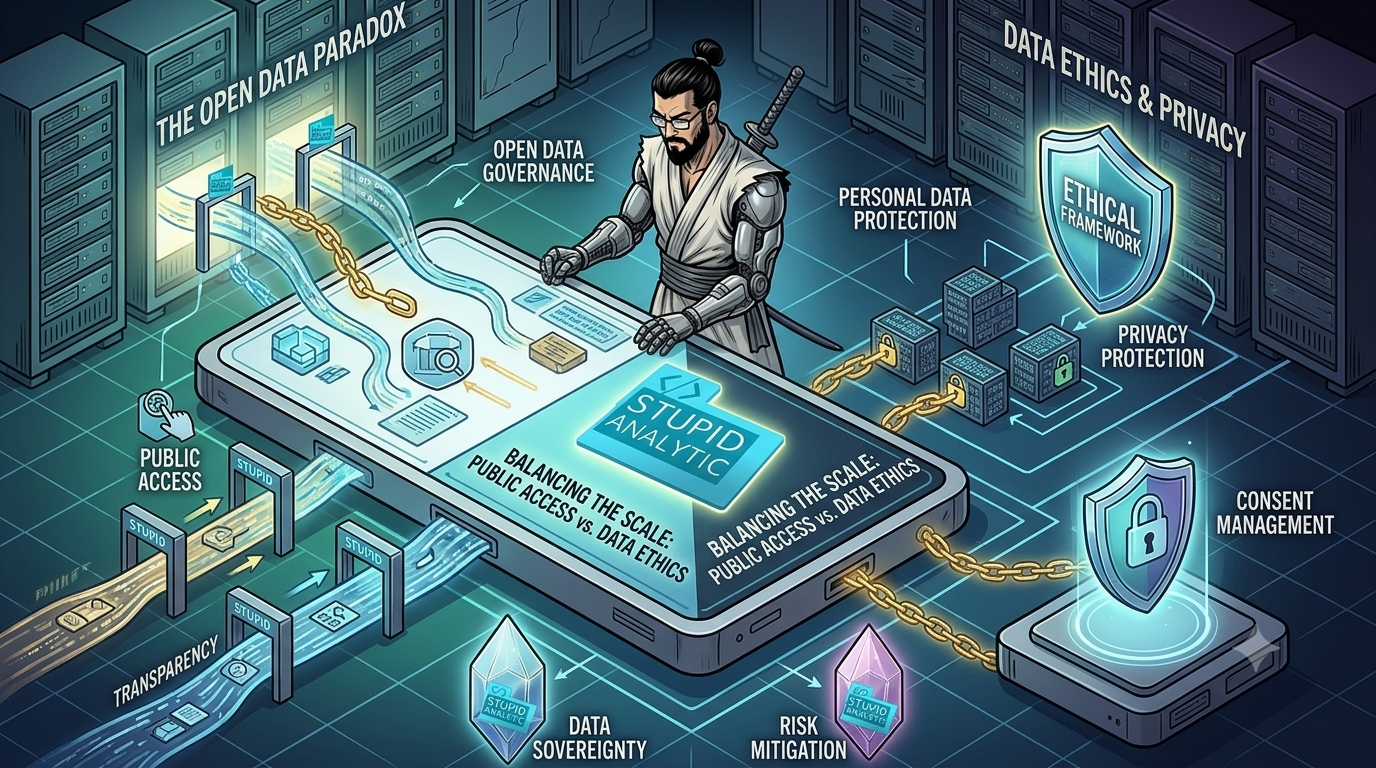
As data analytics continues to evolve, the conversation surrounding modern data governance has split into two crucial, intersecting paths: data privacy and open data. For an aspiring or practicing data analyst, mastering the nuances of open data isn’t just an academic exercise—it is a core technical and ethical competency required to succeed in any data team.
At a Glance
At Stupid Analytic, we believe in stripping away the corporate jargon to look at how data actually impacts your everyday workflow and society at large. In this deep dive, we will explore the foundational principles of open data, the inherent tension between public data utility and personal privacy, and the top-tier repositories every data professional must bookmark.
What is Open Data in Data Analytics?
In the realm of data science, open data is a foundational pillar of data ethics—the shared framework that governs the moral and responsible collection, analysis, and distribution of information.
Simply put, “openness” refers to the unconditional free access, usage, modification, and sharing of information. According to the foundational definitions established by the Open Knowledge Foundation, a dataset must satisfy three non-negotiable requirements to be considered truly open:
- Public Availability and Accessibility: The data must be accessible to the public as a complete dataset. It cannot be hidden behind a paywall, locked inside a proprietary system, or chopped up into incomplete, unusable fragments. It should ideally be available in a structured, machine-readable format (like CSV, JSON, or Parquet) for seamless programmatic consumption.
- Redistribution and Reuse Terms: The dataset must be provided under explicit legal terms—such as Creative Commons or Open Data Commons licenses—that permit users to reuse, modify, append, and redistribute the data without legal or financial friction.
- Universal Participation: There must be zero discrimination against specific fields of endeavor, individuals, or corporate groups. Anyone—whether a commercial enterprise, an academic researcher, or a hobbyist data analyst building a portfolio project—must have the unconditional right to leverage the data.
If a data repository fails to meet even one of these three structural metrics, it cannot legally or ethically be categorized as true open data.
The Great Open Data Debate: Utility vs. Privacy
The global push for open data isn’t without its controversies. The core of the debate lies in a fundamental trade-off: How do we maximize the collective utility of public datasets while aggressively safeguarding individual privacy?
The Unrivaled Benefits of Open Data
When credible databases are made public, the positive downstream effects on analytical capacity are monumental. Open data allows data teams to:
- Accelerate Scientific and Analytical Collaboration: Cross-functional teams across the globe can work on identical, verified baselines, speeding up research advances.
- Drive Strategic Decision-Making: Governments and enterprises can blend public economic, demographic, or environmental metrics with internal data to build highly accurate predictive models.
- Democratize Machine Learning: Open data provides the massive training pipelines required to build unbiased AI models without requiring multi-million dollar data acquisition budgets.
The Dark Side: Third-Party Data and PII Exposure
The risk intensifies when open data elements intersect with third-party data and Personally Identifiable Information (PII).
- Third-Party Data Risk: This refers to information collected by an entity or digital aggregator that does not have a direct relationship with the user (e.g., ad networks tracking your clicks across multiple separate websites). These third parties use this information to create detailed audience profiles, which help them understand user behavior and target them with highly specific advertising.
- The PII Threshold: Personally Identifiable Information includes any data point that is reasonably likely to identify a specific individual—such as physical addresses, credit card data, Social Security Numbers, medical records, and digital tracking fingerprints.
Because advanced data analytics tools can easily combine multiple seemingly “anonymous” public datasets to re-identify individuals, data analysts face a critical ethical boundary. Everyone wants to keep personal information private. Because third-party data is readily available, we must continuously audit open datasets to ensure that individual privacy is never compromised in the pursuit of public analytical openness.
5 Trustworthy Open Data Resource Vaults for Analysts
For a data analyst, knowing where to look for clean, structured, and legally compliant data is half the battle. While you must always critically evaluate the reliability, freshness, and bias of any dataset you download, these five repositories serve as the ultimate starting points for your next analytics project:
1. Data.gov (U.S. Government Data Site)
As one of the most comprehensive centralized data sources in the world, Data.gov is the gold standard for public sector analytics. It offers hundreds of thousands of datasets spanning agriculture, climate, energy, and commerce.
- Best For: Building descriptive dashboards, performing geospatial analysis, and designing comprehensive data visualizations for portfolio projects.
2. The U.S. Census Bureau
If your analytics workflow requires highly granular demographic, economic, or geographic data, the U.S. Census Bureau is unmatched. It aggregates federal, state, local, and verified commercial data points into massive queryable tables.
- Best For: Customer segmentation modeling, market analysis, and training machine learning algorithms based on population density and income distribution.
3. Open Data Network
Powered by a remarkably powerful search engine and advanced built-in filtering capabilities, the Open Data Network specializes in local and regional data. It allows analysts to instantly isolate clean metrics regarding finance, public safety, municipal infrastructure, housing, and development.
- Best For: Comparative regional studies and building predictive dashboards for civic planning or real estate.
4. Google Cloud Public Datasets (BigQuery Integration)
For analysts looking to hone their cloud database skills, the Google Cloud Public Dataset Program is a phenomenal playground. These curated public datasets come pre-loaded directly within Google BigQuery.
- Best For: Practicing complex SQL joins, window functions, and analytical queries on massive, multi-gigabyte datasets without the overhead of manually downloading or cleaning files.
5. Google Dataset Search
Think of Google Dataset Search as the specialized Google search engine designed specifically for data professionals. It indexes millions of datasets hosted across thousands of digital repositories, universities, and corporate research hubs worldwide.
- Best For: Scouring the web for obscure, highly specific datasets for targeted Exploratory Data Analysis (EDA).
Conclusion: The Analyst’s Ethical Blueprint
As you progress in your data analytics career, remember that data is never just a collection of neutral numbers in a table; it represents real-world environments, businesses, and human lives. Mastering the balance between the universal openness of data and the strict enforcement of data privacy will differentiate you from a basic script runner and mark you as a true strategic data leader.
Bookmark these open data resources, apply strict data ethics to your data extraction pipelines, and keep building your portfolio. For more on Data Ethics read about the 6 Pillars of Data Ethics
Related Reads
- The Open Data Debate: Balancing Public Access with Data Ethics and Privacy
- The Essential Guide to Data Anonymization: Protecting Privacy in Analytics
- 6 Pillars of Data Ethics: The Analyst’s Code of Honour
- 5 Powerful ways to determine Good data and Bad data (Make it ‘ROCCC’ Solid)
- The Essential Guide to Identifying 4 Types of Biases in Data