

The Data Detective: What vs. Why?
Root Cause Analysis is the secret weapon of every great data analyst. In the world of reporting, we often get obsessed with the what.
- What is the bounce rate?
- What is the total revenue?
- What is the count of items in the “>74 Days No Action” bucket?
But a Reporting Analyst who only looks at the what is just a human calculator. To actually build authority and solve business problems, you have to become a detective. You have to ask Why.
And not just once. You have to ask it until it gets uncomfortable.
Table of Contents
The Framework: The 5 Whys
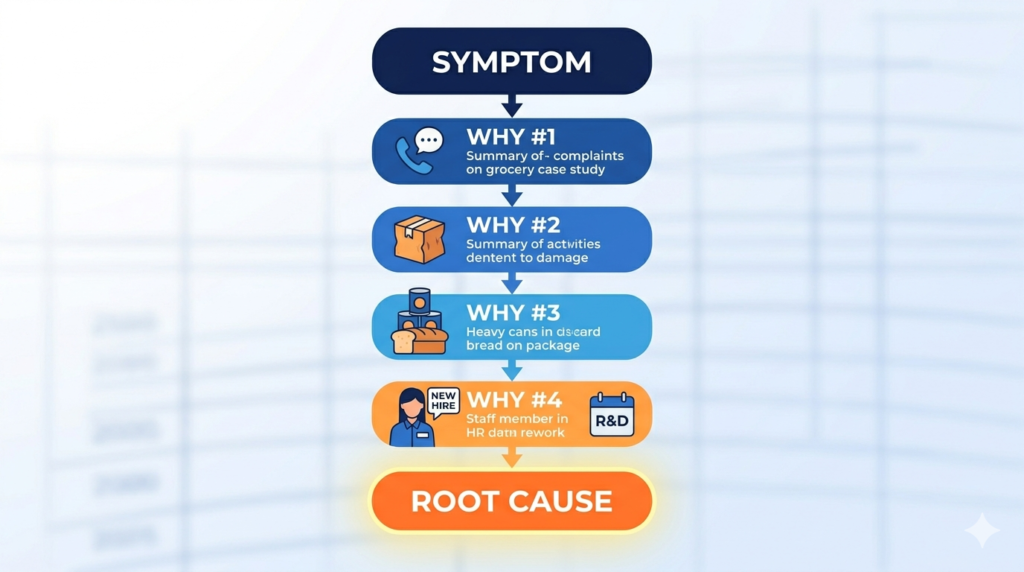
The “5 Whys” is a Root Cause Analysis (RCA) technique originally developed at Toyota to improve the manufacturing process of their cars. The goal is to peel back the layers of a problem like an onion until you hit the core issue that you can actually fix. If you stop at the first “Why,” you’re just putting a band-aid on a broken leg.
Let’s look at a real-world case study of an online grocery store drowning in customer complaints.
Case Study: The Case of the Smashed Strawberries
An online grocer noticed a spike in customer service tickets. The “What” was clear: Deliveries were poor. Most analysts would just build a dashboard showing the spike and call it a day.
Our “Stupid Analytic” hero used Root Cause Analysis instead:
Why #1: Customers are complaining about poor deliveries. Why?
- The Investigation: Looking at the feedback text.
- The Find: 90% of complaints were about damaged products.
Why #2: Products are arriving damaged. Why?
- The Investigation: Analyzing specific photos and comments.
- The Find: The items weren’t broken by the driver; they were packaged poorly before they even left the warehouse.
Why #3: Products are not packaged properly. Why?
- The Investigation: Talking to the warehouse lead and checking logs.
- The Find: The packers didn’t know the procedures. (e.g., putting heavy canned beans on top of soft bread).
Why #4: Grocery packers are not adequately trained. Why?
- The Investigation: Checking HR and hiring data.
- The Find: 35% of the staff were new hires. They were thrown onto the line before finishing their training modules because orders were high.
Why #5: Packers have not completed required training. Why?
- The Final Find: The HR department was mid-rebrand on their training program. Instead of using the old (but working) system, they gave new hires a “one-page cheat sheet” that was totally insufficient.
The Result: Solving the Right Problem
If the analyst had stopped at Why #1, the company might have fired the delivery drivers. If they stopped at Why #3, they might have bought more expensive boxes.
Neither would have fixed the issue.
The Root Cause was an HR transition. By identifying this through Root Cause Analysis, the analyst helped the company pivot resources to finish the training program updates. That is how you create professional authority. You didn’t just “report” the damage; you stopped it.
Why Most Analysts Fail at Root Cause Analysis
Many beginners struggle with this process because they are afraid to step away from their Excel sheets or Power BI reports. They think the “Data” has all the answers.
In reality, the data only tells you that a problem exists. Root Cause Analysis requires you to step away from the screen and talk to people. You have to interview stakeholders, walk through the warehouse, or look at the physical training manuals.
If you want to be a “Stupid Simple” expert, remember that the numbers are just the symptoms. A high percentage of “No Action” invoices in your SAP download isn’t the problem—it’s the symptom. The problem might be a broken email filter or a lack of training on the new software.
Conclusion: The Tool vs. The Brain
You can have the best Power BI DAX measures in the world, but they won’t tell you that HR is using a one-page PDF instead of a training video.
The Tool provides the breadcrumbs; the Analyst does the walking.
Next time you see a weird dip in your website traffic or a spike in your reporting errors, don’t just “fix the data.” Perform a proper Root Cause Analysis and ask Why five times. You might find that the problem isn’t in your SQL code—it’s in a process you haven’t even looked at yet.
Also Read:
https://stupidanalytic.com/data-analytics-process-masterclass
Follow us: www.youtube.com/@stupidanalytic4853