

Data-Driven vs Data-Inspired Analysis
In the modern business landscape, we are often told that “data is king.” However, as any seasoned Data Analyst knows, simply having data isn’t enough; the way you apply that data determines the success of your strategy. Most professionals fall into one of two camps: Data-Driven vs Data-Inspired.
At a Glance
Understanding the nuances between these two methodologies is a core part of “Data Thinking.” Whether you are following the Google Data Analytics framework or optimizing corporate automation workflows, choosing the right approach can be the difference between a clinical success and a creative breakthrough.
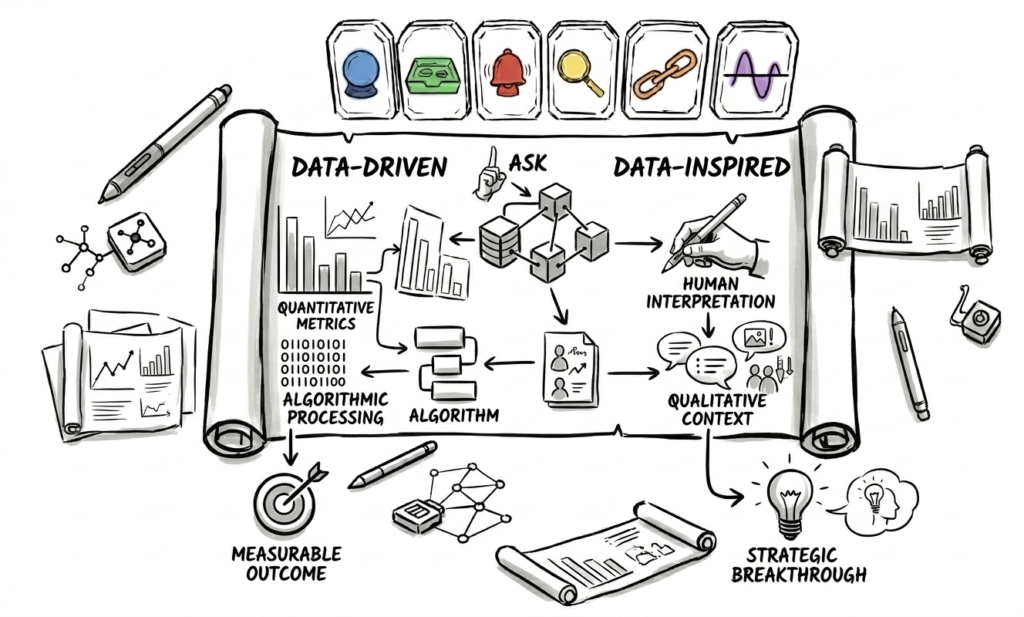
What are Data-Driven Decisions?
Data-driven decision-making means using hard facts, metrics, and processed data to guide a business strategy. In this model, the data is the ultimate authority. You analyze the numbers, and the numbers dictate the path forward. It is the “Stupid Simple” approach to optimization.
The Power of A/B Testing
A classic example of a data-driven approach is A/B testing. Imagine a website selling widgets that wants to test a new layout.
- The Process: For two weeks, 50% of visitors see the old layout, and 50% see the new one.
- The Result: The analyst compares the conversion rates. If the new layout sold 15% more widgets, the company switches to the new design.
The decision is objective, repeatable, and removes human guesswork.
The Risks of Being “Strictly” Data-Driven
While powerful, this approach has limitations:
- Quality & Quantity: If your data is biased or insufficient, your decision will be flawed.
- Historical Bias: Data tells you what happened, not necessarily what will happen in a changing market.
- Ignoring the “Why”: It tracks behavior but often misses the qualitative reasons behind that behavior.
What are Data-Inspired Decisions?
In the debate of Data-Driven vs Data-Inspired, the “inspired” side is often misunderstood. Data-inspired decision-making uses data as a starting point rather than the final destination. It adds a layer of human complexity, bringing in comparisons to related concepts, personal experience, and measurable “feelings” that a spreadsheet might miss.
This distinction is a key element of the Google Data Analytics Professional Certificate. Understanding how to ‘Ask’ the right questions before touching a dataset is a foundational skill taught in the early modules of the program.
The Holistic Support Center Example
Consider a customer support center aiming to improve its CSAT (Customer Satisfaction) scores.
- The Data: The manager looks at the 1–10 ratings.
- The Inspiration: Instead of just looking at the average score, the manager reads the qualitative descriptions, interviews the support representatives, and observes the team’s stress levels.
By combining the quantitative (the scores) with the qualitative (the interviews), the manager formulates a strategy that addresses the root cause of the problem, rather than just chasing a higher number. This is a hallmark of the Data-Inspired approach.
Key Differences at a Glance
| Feature | Data-Driven | Data-Inspired |
| Primary Goal | Efficiency & Accuracy | Innovation & Context |
| Source | Raw Numbers & Metrics | Numbers + Human Experience |
| Best For | Optimization & Testing | Strategy & Problem Solving |
| Risk | Overreliance on the past | Subjective bias |
Choosing between these two paths is the most critical step of the discovery process. For a practical example of this in action, see my guide on the SMART Framework Case Study, where we use specific questions to define these boundaries for a stakeholder.
The Hybrid Strategy: Data-Informed Decision Making
While the debate of Data-Driven vs. Data-Inspired often presents them as opposites, the most successful organizations utilize a “Data-Informed” hybrid. In a data-informed culture, you use the Data-Driven approach to create a baseline of truth (the “What”) and the Data-Inspired approach to explore the potential (the “If”).
For example, if your Power Automate Desktop flow is failing 10% of the time, the data-driven move is to fix the script error. However, a data-inspired analyst might notice that the failures only happen during high-volume corporate holidays. Instead of just fixing the code, they propose a strategic shift in when the data is processed, turning a technical fix into a workflow innovation. This “holistic” view is what separates a standard reporter from a true Data Warrior.
Which Approach Wins in Analytics?
When you are in the ASK and PREPARE phases of a project (central to the Google Data Analytics course), you must identify which path your stakeholders prefer.
- Use Data-Driven methods when you need to optimize a specific process where the variables are clear, such as email open rates or automating file transfers between RDP and SharePoint.
- Use Data-Inspired methods when you are tackling “big picture” problems, such as brand identity, YouTube content pivots, or improving long-term user engagement.
Ultimately, the most effective analysts are those who can navigate both. By being data-driven, you ensure your foundation is solid; by being data-inspired, you ensure your solutions are human-centric and creative.
Follow us for more: www.youtube.com/@stupidanalytic4853
Now that you know the difference between Data-Driven and Data-Inspired decision making, seeing it in action with real-world examples will take you one step ahead. Check the Case study here: