

What is an SOW – Scope of Work
In the world of analytics, jumping straight into a dataset without a plan is like a warrior entering a forest without a map—you’ll likely get lost, and you definitely won’t know when you’ve reached your destination. This is where the SOW i.e. Scope of Work document (also called a Statement of Work across some organizations) comes in.
SOW for Data Analysts is more than just a formal requirement; it is the foundational map that ensures every warrior—whether an analyst, stakeholder, or engineer—stays on the same path. In the world of analytics, jumping straight into a dataset without a plan is like entering a dense forest without a compass. This article explores why a Scope of Work (SOW) is your most important document for project success.
At a Glance
For a Data Analyst, the SOW isn’t just paperwork; it’s the foundational document that ensures every contributor, sponsor, and stakeholder is moving in the same direction.
Why Do Data Warriors Need an SOW?
The primary goal of any data project is to solve business problems. Without a clear SOW for Data Analysts, “scope creep” can turn a simple reporting task into an unmanageable overhaul of an entire enterprise system.
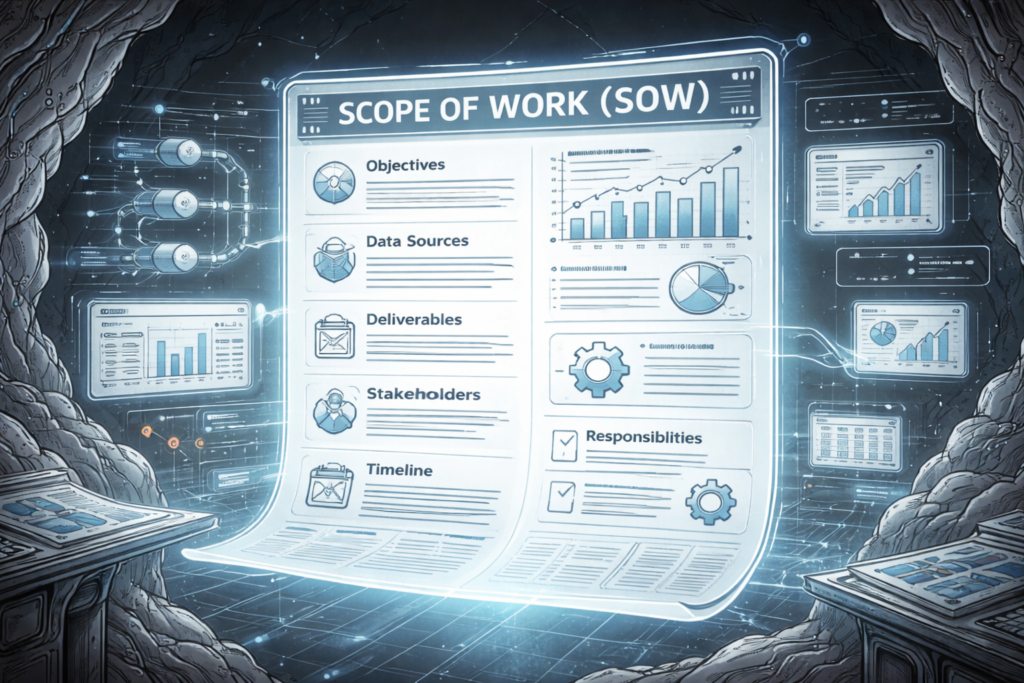
An SOW helps you:
- Clarify Requirements: It forces you to ask the right questions during the “Ask” phase of the Data Analysis Process.
- Set Expectations: It ensures all contributors and sponsors share the same understanding of the project’s relevant details.
- Define Boundaries: It helps you make a distinction between the business questions you are responsible for and those you are not.
The 4 Pillars of a Strong SOW
While formats differ across organizations (check out PMI’s Roadmap for an SOW for reference), every high-quality SOW for Data Analysts must contain these foundational pieces:
1. Deliverables: The Tangible Results
What work is being done, and what is being created? Be specific (for a detailed questioning framework read the blog on SMART Questions). Instead of saying “fixing traffic problems,” a Data Warrior defines the scope with measurable goals, such as identifying the top 10 issues within city limits.
2. Milestones: Tracking Progress
Milestones are the checkpoints of your journey. They help you know when a specific part of the project is considered complete. Examples include “Collect and process 50% of required data” or “deliver completed dashboard visualizations”.
3. Timeline: Mapping the Quest
Your timeline maps expectations for how long each step should take. It answers when deliverables will be completed and if the project is currently on schedule.
4. Reports: Setting Communication Boundaries
Good SOW for Data Analysts set boundaries for how and when you will provide status updates. Will you report weekly or monthly? What information will these reports contain? Establishing this early prevents constant, uncoordinated inquiries from stakeholders
Download the exact Statement of Work blueprint that turns messy reporting requests into clear, automated project wins. Click the button below to download for Free.
Defining the Borders: In-Scope vs. Out-of-Scope
The “Scope” is the heart of the document. It defines everything you are expected to accomplish with a level of detail that leaves no room for ambiguity.
For instance, if you are studying environmental effects on a coastline, a professional SOW for Data Analysts would define the area using specific GPS locations or landmarks rather than a vague description. This quantitative approach ensures that everyone has a clear understanding of expectations. Anything not explicitly listed—such as real-time data pipelines or live data outcomes—is considered “Out of Scope”.
Moving from Tool Expert to Strategic Architect
By mastering the SOW for Data Analysts, you move beyond being a technical “tool expert” to becoming a strategic architect. This document is your shield against shifting requirements and ensures that your technical skills—whether in Power BI, SQL, or Python—are applied to the right problems.
Stupid Pro-Tip: Clarity is your sharpest blade. Use it to cut through the fog of vague requirements before you write a single line of code.
If something changes in the project, your SOW must reflect those changes. Keeping this document updated is the mark of a true Data Warrior who values accuracy and relevance above all else.
Final Thoughts for the Data Strategist
At its core, the SOW is a living document. If the project’s goals shift, the SOW must be updated to reflect that change. By mastering the SOW, you move from being a “tool expert” to a strategic architect who delivers exactly what the business needs—no more, no less.
Follow us for more: www.youtube.com/@stupidanalytic485
Also Read: