

Filling gaps with Data Analyst Communication
In the high-stakes world of technical reporting, your SQL queries and DAX measures are only as powerful as your ability to explain them. You can build the most complex automated dashboard in the world, but if the Product Manager doesn’t understand why the timeline shifted, the project is a failure.
At a Glance
Data analyst communication isn’t just a “soft skill”—it is a functional requirement. To transition from a technician to a strategic architect, you must master the art of the “Stakeholder Handshake.”
Why Data Analyst Communication is a Strategic Pillar
Many professionals focus solely on Python or Power BI, forgetting that effective data storytelling (External Link) is what actually moves the needle in corporate environments. Whether you are writing a technical brief or an executive summary, your goal is to reduce “noise” and increase “signal.”
The 4-Question Framework for Every Request
Before you open Outlook or Slack, perform a quick “Audience Audit.” As a Reporting Analyst, you shouldn’t just dump data; you should provide clarity. Ask yourself:
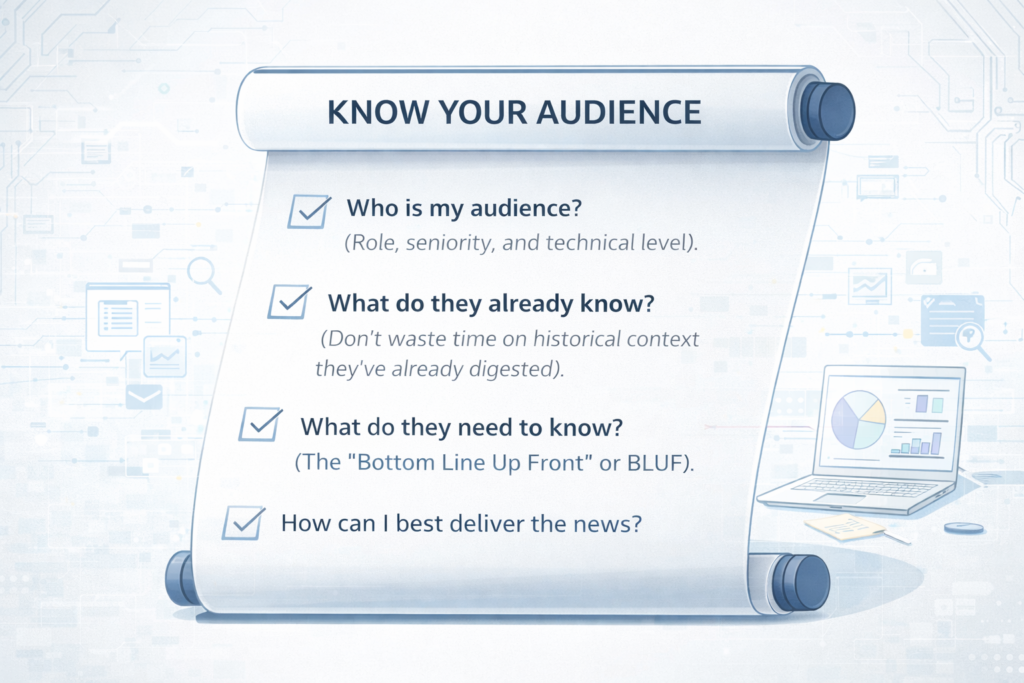
- Who is my audience? (Role, seniority, and technical level).
- What do they already know? (Don’t waste time on historical context they’ve already digested).
- What do they need to know? (The “Bottom Line Up Front” or BLUF).
- How can I best deliver the news? (Is an email enough, or do we need a 15-minute sync?)
Scenario: Mastering Data Analyst Communication During “Scope Creep”
Imagine you’re a data analyst for a mobile app company. A Product Manager (let’s call her Kiri) wants to add a new variable to an ongoing analysis. This is a classic “Scope Creep” scenario that requires precise data analyst communication to manage expectations without damaging the relationship.
Sample 1: The Timeline Adjustment Email
This email uses the four-question framework to manage a potential project delay professionally:
Subject: Update: App Analysis Project Timeline & Data Integration
Hello Katie,
Thank you for the update regarding the new data variables. I understand the importance of including these insights for the Product Development team.
To ensure the data is accurate, we will need to extend the collection phase. This will shift our final delivery date by two weeks. > I am finalizing the revised milestones now and will send a full report this Monday. This report will include our latest findings and the updated project roadmap.
If you’d like to discuss how this impacts your team’s current sprint, I’m available for a quick sync tomorrow morning.
Best, [Your Name]
Sample 2: Professional Follow-Up and Distribution
Once the “Data Warrior” has conquered the analysis, the follow-up is about distribution and support. Consistent data analyst communication builds trust over time.
Subject: Released: App Analysis Report (Updated Data Included)
Hello Katie,
The app analysis report is now live, and I’m pleased to share that we are hitting all milestones on our revised timeline.
I’ve attached the full report, which now includes the new variables we discussed. You’ll find fresh insights on [Variable X] in Section 3.
Please share this with your team. If anyone has questions regarding the methodology, feel free to reach out.
Advanced Data Analyst Communication: Why Strategy Beats Syntax
Great communication prevents the “Silent Failure.” When stakeholders know exactly what to expect, they can manage their own resources and schedules.
If you are following The Reporting Analyst’s Roadmap (Internal Link), you know that strategic architecture requires clear documentation. Carefully worded responses are key. Whether you gather feedback via email, meetings, or reports, everyone you work with will know what to expect. As a result, they will be able to better manage their own schedules, resources, and teams.
For more on technical standards, check out Tableau’s Guide to Data Storytelling (External DoFollow Link) which emphasizes the importance of sharing data-driven findings.
Final Strategic Takeaways:
- Emails are Records: Use them to document timeline shifts.
- Be Proactive: Don’t wait for the deadline to pass before mentioning a delay.
- Offer the Meeting: If the news is “Negative” (like a delay), always offer a face-to-face sync.
Follow us for more: www.youtube.com/@stupidanalytic485
Also Read: