
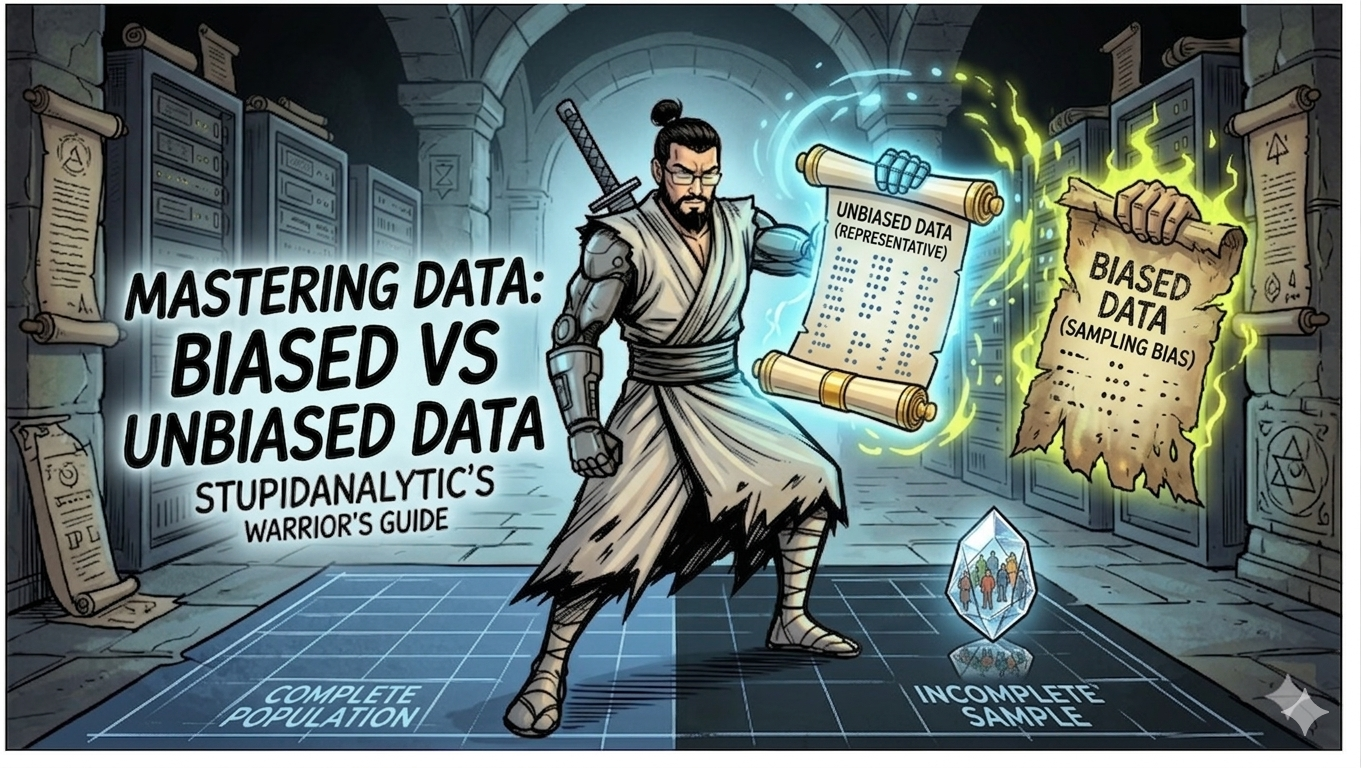
Biased and Unbiased Data
In the world of professional analytics, the integrity of your insights is only as strong as the integrity of your input. Whether you are transitioning from Impala to Snowflake or building a Power BI matrix, understanding the distinction between Biased and Unbiased Data is the first step toward becoming a true Data Warrior.
When we discuss the “shape” of information, we aren’t just talking about Long vs Wide data structures; we are talking about how accurately that data reflects the real-world population it claims to represent.
At a Glance
What is Biased Data?
Biased data is defined as information that does not accurately represent the entire population being analyzed. In many technical workflows, bias occurs when the data is incomplete or heavily weighted toward a specific subset of the population.
Imagine you are analyzing the performance of a global corporation, but your dataset only includes entries from the headquarters. This is a classic example of Biased data because it excludes the nuances and diverse samples from regional branches.
Key Characteristics of Biased Data:
- Incomplete Representation: It only captures a “slice” of the population.
- Skewed Inputs: It results in partial insights that can lead to disastrous business decisions.
- Non-Random Collection: Samples are often gathered based on convenience rather than statistical rigor.
Essentially, Biased and Unbiased Data discussions often center on Sampling Bias. If your sample is flawed, your entire analysis is a misrepresentation of the whole.
Understanding Sampling Bias
Sampling Bias is the “silent killer” of accurate reporting. It occurs when certain members of a population are systematically more likely to be selected for a study than others. As a Reporting Analyst, identifying this is critical before any data transformation occurs.
If you only collect samples from a specific part of the population, you are not performing a comprehensive analysis. You are merely looking into a “distorted mirror.”
What is Unbiased Data?
Unbiased data is the gold standard for any analytical project. It is the exact opposite of biased data. In an unbiased dataset, the sample is collected randomly from every possible aspect of the whole population.
Why Unbiased Data is Vital:
- High Reliability: It provides a comprehensive view that can be relied upon for strategic planning.
- Randomized Collection: Every segment of the population has an equal chance of being represented.
- Statistical Integrity: It ensures that your SQL queries or Snowflake models reflect real-world distributions.
When you work with Biased and Unbiased Data, your goal is always to move toward the unbiased side of the spectrum to enable a more holistic data analysis.
Biased and Unbiased Data: A Side-by-Side Comparison
| Feature | Biased Data | Unbiased Data |
| Population Coverage | Partial/Incomplete | Full/Comprehensive |
| Collection Method | Non-random/Specific | Randomized/Generalized |
| Accuracy Level | Low (Misleading) | High (Reliable) |
| Analytic Outcome | Misrepresentation | True Insight |
Before you start “unpivoting” your data or creating complex DAX measures, ask yourself: “Is this sample truly representative?” If the answer is no, your Data Transformation Process will only amplify the existing errors.
Key Takeaways
To summarize, the distinction between Biased and Unbiased Data rests on the method of collection. Sampling Bias occurs when a dataset represents only a fragment of the population, leading to incorrect inputs. Conversely, Unbiased Data utilizes randomized sampling to provide a comprehensive and reliable overview of the whole population. Mastering these concepts is essential for anyone pursuing advanced data modeling or high-level reporting.
Want to dive deeper into data? Check out our other guides in the Data Basics section.
Follow us for more: www.youtube.com/@stupidanalytic485
Also read: